The Lucky Charm Is Decoration, Not an Explanation
A casino lucky charm can shape a room’s look, but it cannot explain game rules. Learn what to observe, what to verify, and how to describe it clearly.
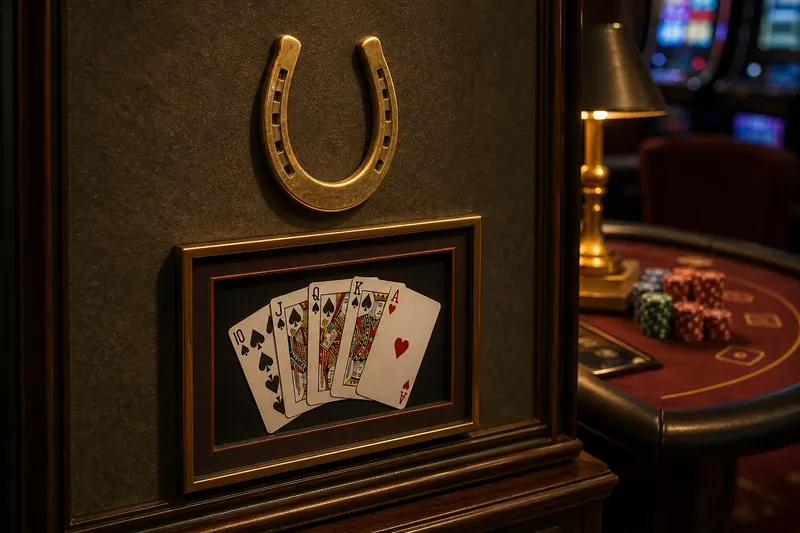
A brass-colored horseshoe hangs above a display of playing cards, with no wording beside it. A casino lucky charm can draw the eye, but its location alone does not explain a game rule or venue policy.
For a DTU discussion of casino culture, treat the charm first as a designed object: describe its form, placement, and relation to nearby items. Check posted rules or ask staff only when your question concerns play or venue policy.
How should you describe a casino lucky charm?
Record details you can see: the charm’s material or finish, shape, mounting method, and nearby objects. Then describe its visual effect. It might echo the card display, contrast with a plain wall, or serve as a focal point.
Keep interpretation separate. “A horseshoe hangs above the cards” is an observation. “The venue placed it there to announce a special rule” is a claim about purpose that needs confirmation.
What makes an object an official instruction?
Look for wording that states a rule, a clear connection to a posted rules display, or an explanation from venue staff. An ornament does not become an instruction simply because it is near a table or sign.
If you need to know how a game works, read the posted rules or ask staff. Do not use a charm, color, or image as a substitute for that information.
Which details should guide your next move?
- If the object carries explicit instructions, read the wording and check what it applies to; if the wording is absent or unclear, consult the posted rules or ask staff.
- If the object sits inside a rules display, read the surrounding text for a stated connection; if it is separate from the display, do not infer a rule from proximity.
- If staff explain the object’s purpose, attribute the explanation to the venue; if no purpose is confirmed, describe its visible form and position.
- If you are writing a design critique, note the object’s placement and visual effect; if its intended meaning is unknown, label your reading as interpretation or omit it.
- If the object is merchandise, discuss its design or personal appeal; if your question concerns a game, check the game’s posted rules instead.
- If you do not know an image’s cultural context, consult a reliable source or a knowledgeable person; if you cannot confirm the context, avoid presenting a guess as fact.
Say a DTU student is describing a room that contains one brass-colored horseshoe and one printed card display. The student notes that the horseshoe hangs above the display, reads the nearby rules, and asks staff whether it has an official role. If the rules do not mention it and staff call it an ornament, the student can describe its decorative placement without assigning it a game function. If staff identify a specific purpose, the student can report that explanation as the venue’s account.
It is not worth the effort to assign a hidden meaning to every ornament. Focus on the object’s visible design unless your question specifically concerns rules, policy, or stated intent.
What do people ask about casino lucky charms?
Does a casino lucky charm affect a game?
The charm alone does not establish anything about game outcomes or rules. Consult posted information or ask venue staff about conditions of play.
How can you tell if a casino symbol is an official sign?
Look for explicit wording, a clear link to a rules display, or confirmation from the venue. Otherwise, describe it as an object in the room.
What belongs in a design critique of a casino charm?
Describe its appearance, location, and visual relationship to nearby elements. Present proposed meaning as interpretation unless the venue confirms it.
Can a casino-themed object have personal meaning?
A visitor may have a personal or cultural association with an object. That association does not establish the venue’s intent or explain its rules.
What can you fairly claim about a lucky charm?
A casino lucky charm may be decorative or personally meaningful. For a clear description, state what the object looks like and where it appears; use posted rules, staff explanations, or venue statements for claims about play and policy.
That distinction is useful in a DTU design discussion: the charm can contribute to the room’s visual character without serving as an explanation of how the room operates.